

I have had a number of very kind and supportive messages over the last few weeks from paid subscribers and people buying me coffees. I want to take this opportunity to thank all of you: I appreciate it very much.
Meanwhile, these essays will always be free, but you can continue to support my work by liking and commenting, and most of all by passing the essays on to others, and passing the links to other sites that you frequent. If you would like to take out a paid subscription I won’t stand in your way, (I’d be very honoured in fact) but I can’t promise you anything in return except a warm feeling of virtue.
I have also set up a Buy Me A Coffee page, which you can find here.☕️ Thanks to all of those who have recently contributed.
And as always, thanks to others who tirelessly supply translation in their languages. Maria José Tormo is posting Spanish translations on her site here, and Marco Zeloni is also posting Italian translations on a site here. And many of my articles are now on line on the site Italia e il Mondo: you can find them here. I am always grateful to those who post occasional translations and summaries into other languages just as long as you credit the original and let me know. And now:
******************************
Last year, I wrote an essay on Peoples, States and Borders, which aroused a degree of interest. It was largely a critique of the concept and the implementation of the nation-state, describing the incoherence of the concept, and the problems that the infamous “self-determination of peoples” has caused. As often, a number of the comments were of the “why didn’t you mention …” or can’t you say something about …” variety, and I duly noted them away in the little black book section of my brain for future use.
What brought this to the front of the queue of things I was vaguely thinking of writing about, were the events in Syria and on the Syrian border with Lebanon over the last few weeks. Suddenly, it’s Druze and Alouite and Shia and Christian communities again, and they can’t have the decency even to all be in one country at a time. Thinking about the implications of this, it struck me that there is much more to be said about some of the basic and very serious mistakes in the way that the West and western-aligned international institutions look at crises. Given that, their attempts to resolve many of today’s crises resemble attempts to open a tin of beer with a screwdriver. Hence this essay.
And notice I’ve just said “international,” thus neatly illustrating the problem. Nations exist, the sovereign equality of states is a legal principle, if not always respected in practice, treaties are (usually) between states, and international organisations consist, by definition, of nations. We thus have a conceptual framework (never mind the supporting academic disciplines and international bureaucracy) which suggests that nations are not merely the de facto actors in the world system, but by extension the source at once of the problems and the solutions. Yet if you think about it, this isn’t really true, and never has been.
To take the two most obvious current examples, is there a war between “Russia” and “Ukraine” and one between “Israel and “Palestine?” Is that the most useful way to look at each problem and at potential solutions? Yes, there is a government in Moscow and one in Kiev, and the Russians object to Ukrainian government increasing links with the West, but how does that explain internal events in Ukraine since 2014 or Russian war aims? I’ve noticed that talking about the civil war in the West of the country causes some peoples’ brains to seize up: partly because this implies that the world did not begin in February 2022, but mainly, I think, because it loosens the straitjacket of context-free, state-to-state conflict in a historical vacuum which the conventional narrative imposes. Likewise, if someone asks you “do you support Ukraine?” and you reply “which part?” you risk physical harm. It simply isn’t possible for most people to genuinely internalise the idea of communities and actors and problems that cross frontiers, have their origins deep in history and are the consequence of systems of government we read about only in history books: we lack the words to describe such problems properly, let alone to think of responses. Pretty much all the discourse about “negotiations” between Russia and Ukraine, especially concerning territory, misses the fundamental point that both became western-style nation states only very recently in historical terms, and this isn’t a border dispute.
Likewise, running around with Palestinian flags not only shows that you don’t really understand the situation, it does nothing to help those suffering in Gaza, and arguably sets their cause back by recasting the massacres as a football match that you want your side to win. Thus, rather than a series of widespread and terrible massacres, the situation is coded as a war between “Israel” and “Palestine,” to be concluded, in the fantasy land that some on the Notional Left inhabit, with the successful occupation of Israel by the Palestinian Army, much as the FLN was thought to have “liberated” Algeria. The effect is to ghettoise opposition to the destruction of Gaza and drive away potential sympathisers, by assimilating protest into the model of a war between two states, which it clearly is not. This not only contravenes the most basic principles of political mobilisation, it radically misunderstands and distorts the basic situation.It seems perverse, after all, to devote all your energies to performatively “supporting” the victims, as opposed to demanding of the perpetrators that they just stop it, and trying to persuade your government to put pressure on them to do so. (The official poster for the 2025 Gay Pride march in Paris featured the Palestinian flag, which the demonstrators were also strongly urged to carry, to underline that Hamas and the French homosexual community were essentially on the same side.)
If instead we see the (one-sided) conflict as the result of a successful attempt by an identity group of outsiders, with a claimed historical justification, to violently occupy and dominate part of one of the multiethnic territories of the former Ottoman Empire, and subsequently attempt to extend that domination by violent means to other parts of the same former Ottoman territories, then a lot of what has seemed puzzling becomes much clearer. Of course to do that, we have to put on one side for a moment concepts like “state,” “nation,” and even “government,” and to recognise that these are in practice nothing more than transient political and ideological superstructures erected over communities and territory, all based essentially on physical power. Thus, questions of the “borders” between Israel, Syria and Lebanon are essentially a result of asking questions that start from the wrong assumptions.
Naturally, the power of the norms of the current system make this very hard to wrap one’s neurones around. Indeed, for any significant number of people to take this line of thinking seriously for any length of time would seriously destabilise what is generally called the “international system.” Yet in reality, not only is there nothing magical about this “international system,” it is actually a recent and somewhat equivocal ideological novelty in world politics.
Consider: it is based on the assumption of a clear and unmistakeable identity between political borders and populations. The resulting entities, then, should have governments that in general reflect the wishes of the inhabitants, albeit with some disputes about economic issues at the margins. These days, people move around freely between states much as they may transfer their allegiances to football teams, or sell shares in one company and buy them in another. States all operate in fundamentally the same manner, and according to the same sets of priorities and objectives. International relations is largely a question of settling administrative disputes between states, much as a tribunal of commerce might do between private companies.
Of course, there is a large instrumental element to all this. For the current system to function at all, let alone for the academic international relations industry to survive, radical over-simplifications of this kind are essential. The problems arise when real crises break out, since they rarely if ever follow nation-state logic. So for example the current tidy legal distinction between “international” and “non-international” armed conflicts is hardly ever found in reality. Experts on actual conflicts argue that it is almost impossible to separate internal and external factors, and one can become the other depending on which end of the chain of argument you start from. Because of the nature of conflicts themselves, they very seldom respect state borders: after all, the simplistic model of administrative disagreements between states is not the sole origin of many conflicts. Similarly with crime. The disintegration of the state in Libya means that “transnational” organised crime (TOC) in Africa and the Middle East now effectively ignores notional and fragile state boundaries altogether, and human and other trafficking flows between Africa, the Gulf and the Levant have essentially reverted to the routes used by the slave trade before the era of western colonisation. The “nations” in TOC might as well not exist. Thus, attempts to fight human trafficking on an “international” basis incorporate an obvious paradox, for all that there is no other obvious framework in which to do it. (Ironically, the creation of nation-states with frontiers, entry requirements and customs duties, actually creates some of the very problems of TOC that state cooperation is intended to combat, and which did not exist in earlier times)
Such was the speed and thoroughness of the blitzkrieg-style normalisation of the nation-state model that we forget how recent it is. Barely a century ago, the vast majority of the population of the world lived under other forms of government, if indeed “government” was even the word. Traditional Empires, in Africa, Europe or the Middle East, were loose political structures where communities lived next to each other, harmoniously or not. Because political power was in the hands of rulers, their appointees and their surrogates, “politics” as we understand it today scarcely existed. Rival communities did not compete for power over the area where they lived, because there was no power to acquire: it was all held by someone else, somewhere else. However, small communities could and did seek Imperial favour and power by serving as military forces or in the administration.
All of which doesn’t matter until it does. Why, after all, did ethnic Serb communities in parts of Croatia revolt against Zagreb when Croatian independence was approaching in 1991? And what were they even doing there? Well, they were the descendants of Serbs who, together with others, had moved to the Military Frontier (Militärgrenze) of the Hapsburg Empire from the seventeenth century, to form a professional, hereditary barrier to Ottoman attempts to penetrate further North and West. It seemed a good idea at the time. And why was there a Muslim community in Bosnia, of all places? Well, they were Serbs who had converted to Islam to become the neocolonial ruling class at the time of the Ottoman Empire. It seemed a good idea at the time, too.
But the phenomenon is pervasive, and the world is littered with the incidental debris of Empires that passed that way, sometimes at the most banal level. Alexandria in Egypt was so named by Alexander the Great, passing through on his world conquest gig. “Cairo", on the other hand comes from the name the Arab invaders gave to the new city they founded near existing Roman colonial fortifications. The name of the city of Lagos in Nigeria appears to come from the Portuguese for “lakes,” recalling the Portuguese navigators who passed that way. The city of Chester in England is a corruption of the Latin Castra, meaning “military camp,”and many English towns have names deriving from the Latin. The city of Kabul appears to have been renamed every time one of the numerous waves of imperial invaders passed that way. The city of Tripoli in Libya is derived from the Greek for “three cities,” reflecting Greek colonisation of a Phoenician colony, soon to be overtaken by Roman colonisation in turn. “Benghazi” on the other hand is a name given by Arab colonists to an earlier Roman colonial city. And so on and so on: the shores of the Mediterranean and the lands further East betray layer upon layer of colonial heritage of everything from language to religion to food to community organisation, going back thousands of years.
Everywhere the Ottomans trod (and they trod on a lot of people) they left a series of unexploded bombs behind, some of which are still going off. It’s not their ‘fault:” they were no more capable than any other Empire of imagining their own demise and the rise of something as bizarre as the nation-states that were to follow them. What seemed perfectly sensible and good administration to the imperial powers of the past, just turned out to be lethal once the territories had suddenly become nation-states. It was partly a question of scale: loose, far-flung Empires could accommodate tensions that smaller nation-states could not, and those tensions often unwittingly sowed the seeds of future conflicts. Thus, before the large-scale arrival of Europeans in Africa, the appetite of the Ottoman Empire and the Gulf Emirates for slaves was such that many tribes in the North and West specialised in raiding for saleable assets. So when independence came suddenly to Sudan in 1956, the British, the rulers by then, decided to make all of the Provinces of Sudan independent as part of the same country, and so (as elsewhere in Africa) leaving the descendants of slave traders and the descendants of their victims in the same country, with tensions that are still very much alive today. Yet again, it seemed a good idea at the time.
Without beating the subject to death, then, it’s clear that a goodly number of the world’s tensions and conflicts come, not directly from deep-seated ancestral antipathies (though there are plenty of those) or instrumentalisation by unscrupulous “entrepreneurs of violence” (though that happens) or even outside interference (though that happens too). Rather, they are often the consequences of the very rapid imposition of a nation-state framework and its associated expectations on societies and territories that were historically organised according to completely different principles.
So deep has been the memory-hole down which the whole concept of Empire has been dropped, that it’s hard now to remember how fundamental Empires were in history, and so how significant their after-effects are even today. (The current obsession with the short-lived and untypical British and French Empires at the expense of the broad sweep of history hasn’t helped either.) But there are several key characteristics of classical Empires that have dropped out of our popular consciousness entirely. One is that they were possessions of rulers and families, not states, and acquired by conquest, treaty or marriage. This is why, for example, the territories of the Habsburg Empire at its greatest extent don’t make a great deal of sense if you assume that they were acquired solely for commercial and strategic motives. Like property-holdings today, they were sometimes fought over, and could even be traded for others, so the War of the Spanish Succession was essentially fought to settle the question of whether the French Crown would be able to add the Latin American territories of the Spanish Crown to its property portfolio. Like leasehold tenants of properties today, the inhabitants themselves might have little contact with the ultimate proprietor, whose identity was often obscure and who would be mostly represented by local managing agents, responsible for tax collection and sometimes military service, but not much else.
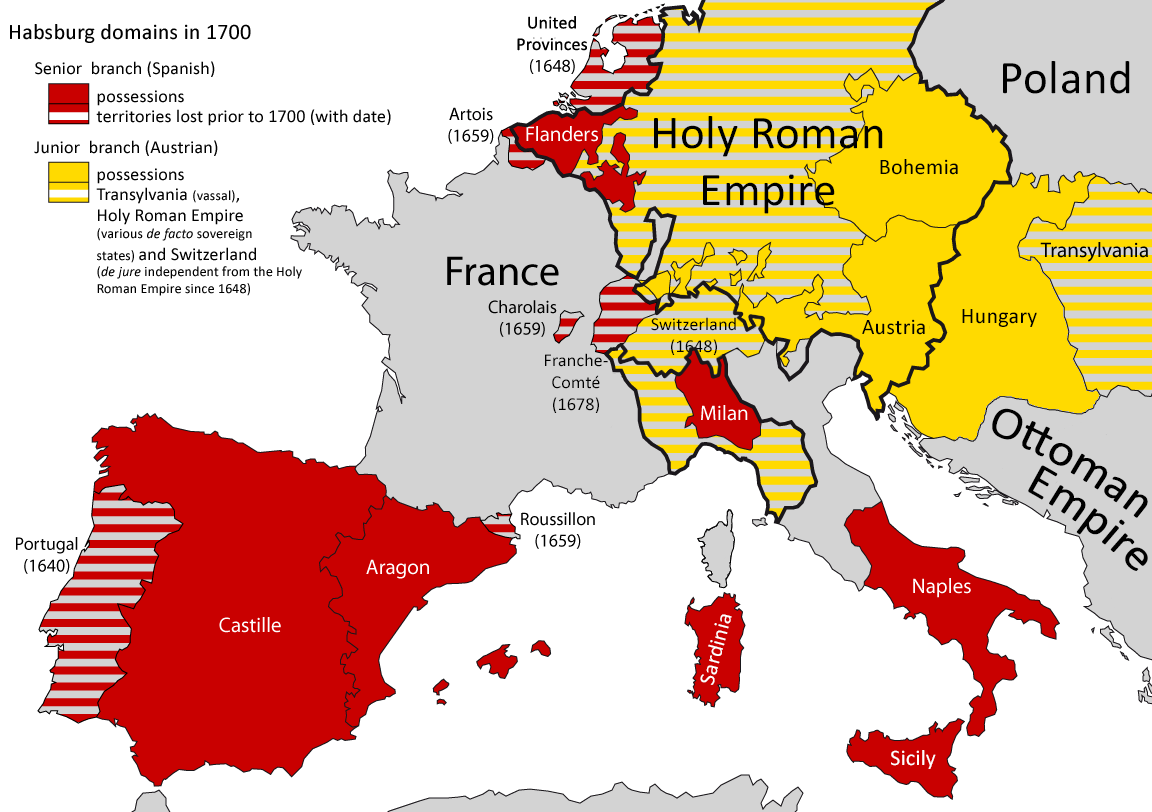
In such circumstances, loyalties were above all local: to cities, regions, communities, languages and traditions. It was perfectly possible to be a member of a small community of faith X in a large city of faith Y, speaking one dialect of language A at home and language B in the street and at school, in a province where the administrative language was another dialect of A and the local Prince a week’s travel away was of faith Z, speaking yet another language still. Nobody thought this was strange, because almost nobody in those days thought of themselves as living in “countries” or “states.” They might think of themselves as “citizens” of a town, as communicants of a religion, as part of a historico-cultural group, and distantly as “subjects” of a faraway ruler they would never see. In Africa, low population density meant that there were quasi-imperial relations between dominant and subordinate tribes and kingdoms, and, for many ordinary Africans, the arrival of European powers in the late nineteenth century just changed the skin colour of the distant ruler. (The effect on urban elites was much more important, and we’ll come to that in a moment.)
Secondly, the borders of Empire were fluid and changed frequently. Out on the margins, there might be very little consciousness of the imperial power: locals might identify more easily with the nearest city across the border. And Empires rose and fell: the Ottoman Empire was famously in retreat from the eighteenth century onwards, and in the usual style the Hapsburgs and the Romanovs moved in to fill the gap, with the Venetians also seeking to recover some of their lost territories. Indeed, to a much greater degree than is often recognised, the First World War was a struggle between Empires: not in the trivial sense of imperial competition outside Europe, but in the sense of the traditional rivalry and occasional wars between crowned heads. We think of “Russia” and “Austria” as countries in 1914, but of course they weren’t: they were multinational, multilingual Empires. Even Britain was at the head of a world-spanning Empire of British expatriates, reinforced by recent acquisitions in Africa, and the French relied heavily for manpower on the only republican Empire since Rome. Thus, soldiers loyal to the King of England fought soldiers loyal to the Kaiser of the Second Reich in what was then Tanganyika, in the traditional style. When it was obvious that the Ottoman Empire in the Levant was falling apart, the British and the French laid plans to move in as was traditional and expected. (It’s not clear what else they could have done, actually, other than allowing chaos and anarchy to develop, and perhaps giving the Ataturk regime a chance to practise its skills recently honed on the Armenians.)
Indeed, it’s striking how far the War was conceived as a clash of Empires even while it was going on, and how adjustments to imperial borders were anticipated as a result, as indeed happened with the Treaty of Brest-Litovsk in 1917. The British and the French saw themselves administering the Middle East as (effectively) colonial territories, much as the Ottomans, the Mongols and the Arabs had done before them. There was no question at the time of the development of new--fangled nation-states. This is the background to the much criticised Balfour Declaration of November 1917, which carefully expressed support for a “national home for the Jewish people” in Palestine, not the creation of an ethno-nationalist state, and which carried the qualification that “nothing shall be done which may prejudice the civil and religious rights of existing non-Jewish communities in Palestine.” This language is only comprehensible if we understand that, if the British were to win the War (far from certain at the time) and they were successful in taking control of Palestine away from the Ottomans then they would facilitate large-scale immigration of European Jews to the territory they would control for strategic reasons, whilst also being attentive to the effects this might produce on the existing inhabitants. As often, later developments impose a frame of reference on past events that the protagonists themselves were not aware of.
The idea of the nation-state can politely be described as a mess, intellectually, politically and practically. Here is an article that summarises its development better than I can, although if anything it’s rather too indulgent to the concept. Its fundamental weakness (and thus of the “international system” we now have), is that there is no agreement on what constitutes a “nation,” other than the tautologous acceptation of an entity as being one such. I’ve discussed before, and won’t repeat here, the hopeless confusion in various languages between concepts of “nation” “people” “state” “group” and “ethnicity,” most of which turn out on examination to be essentially undefinable. The question is why it was ever thought that such concepts could be operationalised to produce viable political entities. The answer seems to lie in popular pseudo-science.
Carefully buried now, the concept of “race” was pervasive a hundred years ago. Simply put, racial theories divided humanity into the equivalent of breeds of plant or animal, each with their own characteristics. In the days when people lived a lot closer to the soil than they now do, this seemed just common sense. Different breeds of dog were recognised to be suitable for particular tasks. New varieties of vegetable could be produced by careful inter-breeding. Most pertinently, nature seemed to be in a state of perpetual competition: grey squirrels drove out red squirrels, for example. Why should human beings be any exception this apparently universal rule?
It followed that the “peoples” of whose self-determination there was so much talk, were genetically distinct from each other, as different breeds of dog were, and thus had different characteristics. Thus, quite seriously, the French were genetically rational, the Italians genetically excitable, the Poles genetically romantic and tragic, the Germans genetically dour and warlike, and so on. Intermarriage, like cross-breeding between dogs, was debatable, since “good” qualities might be less powerful than “bad” ones. (After all, there was no dispute that intermarriage produced offspring with a combination of physical characteristics, so why not psychological ones as well?)
Thus, when “national” groups began to demand self-determination, it all seemed logical enough. The Greeks, after all, were entitled to demand liberation from their Ottoman overlords, from which they were genetically distinct. But as even the fiercest defenders of the nation-state concept had to accept, tracing practical borders around such genetically differentiated groups was another matter entirely. And as we have seen, very few of the resulting territories were, in the discourse of the time, genetically homogeneous. So what to do with minorities? Weren’t they a threat, just because they existed? And what about that area just across the frontier, where our ethnic group is a local majority, even if they are a minority in our just-established neighbour’s state as a whole?
Since differences were fundamental and genetic, compromise was difficult, and were to become even more so with the first stirrings of representative democracy. Minorities were difficult to assimilate, and it was often safer just to expel them: in 1871 the Prussians demanded that the French inhabitants of Alsace and Lorraine either renounce their French identity or simply leave, something that would never have happened previously when provinces changed hands freely. Most of them left. When radical post-Ottoman nationalists decided to call their country “Turkey” (ironically adopting a European name, but at least they spelt it “Türkiye”) they famously said that “the Turks are a people who speak Turkish and live in Turkey.” The Ottomans, for all their faults, were not racially exclusive, and neither the language nor the Sunni Muslim faith was a requirement for living in what became Turkey. But once the nation-state was created, both of these became essential, as the Armenians learned to their cost.
As these examples show, like many others that were to follow, the easiest solution to the nation-state security conundrum was to kill or expel those not of your “people,” while simultaneously conquering adjacent territories where your “people” were, by the same logic, under objective threat. Thus, from the beginning of nation-states in the nineteenth century, the result has been permanent war, but also a permanent inability to solve the underlying problem, which is unsurprising since it has no solution. Well, I say that but, as will be evident, there is a solution of sorts, and it is violence. Here again, there was a pseudo-scientific rationale: just as evolution pitted species against each other in a fancied blind struggle for survival, even so history showed that Empires rose and fell, and countries flourished and declined. War was nature’s way of resolving competition between races, and vae victis.
Unlike the First World War, where this was a minor theme, it can be argued that the logic here is what the outbreak of the Second World War in Europe was very largely about. After all, the mere presence of a large number of German speakers in the Sudetenland was not in itself a trigger for potential conflict. That was the creation of Czechoslovakia, a debatable initiative anyway, with a German-speaking minority which was a majority in a territory awarded to the new country to make it more defensible. The large number of German speakers outside the Reich was only a pretext for war because they were minorities in countries created or recreated after 1919. We can see the same factors operating in Ukraine today. There are endless learned and polemical articles arguing variously that Ukraine is an old-established country, or alternatively that it was never a country at all, that its borders are entirely rational or alternatively utterly meaningless, all supported by different maps and statistics. There is no objective answer of course, in this case as in any other: no identity group in history has ever shrugged its shoulders and said “yes, I suppose you’re right, your claim is better than ours,” and none ever will. That issue will be settled, as it always is, by violence.
The Second World War was an unacknowledged electroshock to this western way of thinking about “race:” the ghastly consequences of taking the idea literally were very visible. This brought about a change in the nation-state discourse, and less emphasis on the self-determination of peoples, now that the Germans had shown what determining yourselves could lead to. Ironically, the last gasp of early twentieth century racial thinking was the Genocide Convention, with its list of groups (national, racial, religious, ethnic) which in most circumstances have no objective existence. Instead, the emphasis switched to vaguely-defined groups, especially the large-scale forced population movements carried out by the Soviet Union after the War, which did a lot to secure support for the idea of the Convention in the first place.
In the aftermath of 1945, Britain and France vaguely assumed they would retain their Empires, which, after all, had been a source of enormous strength in the recent war. Some time in the future, decades, generations, who knew, there might be European style countries in Africa, but in the meantime, the Empire meant Great Power status, as Empires always had, and the costs were judged acceptable. This changed radically in the 1950s, primarily for economic reasons, but partly also because a small but militant African intelligentsia, generally educated in Europe or by Europeans, wanted to implement the European nation-state model in Africa. In the past, such people had been treated as subversives, and sometimes imprisoned, now they were let out and encouraged to form states of their own. As with most imported ideas, the results were equivocal, as the desire to emulate the former colonial masters ran ahead of the capacity to do in years what elsewhere had taken centuries, and produced what Basil Davidson long ago called the “curse of the nation-state” in Africa. (I have argued, and found support from many Africans, that uncritical importation of western ideas by African urban elites has been at least as damaging as western attempts to export those ideas. Africa has an enormously rich heritage of social and political models that have been trampled in the rush to imitate the West.) Apart from countries where there were large western populations (Algeria, Rhodesia, Kenya to a degree) “independence” came quickly and peacefully, without much discussion of what that term actually meant.
But we are probably stuck now with the word “independence” to describe what happened in the 1950s and 1960s, although the implied comparison with, say Poland, once an independent state, swallowed up and subsequently recreated, doesn’t actually explain very much. A good case is Algeria, which became “independent” in 1962 in the sense that a group of western-educated intellectuals founded a movement that sought to create a western-style nation-state under their own control on a territory which had been a colony forever, by violently evicting the most recent colonial power. Yet the concept of Algeria as a “nation” in the western sense would probably not have occurred spontaneously to most of the inhabitants of the new country, even leaving aside the million residents of European extraction who thought of themselves as French. The name chosen by the new rulers was Dzayer, derived from the Arabic Al-Jazair (“the islands”) the language of the Arab conquerors. The original inhabitants of the country, generally known as the Kabyle, itself a corruption of the Arabic word for “tribes,” and still amounting to 10-15% of the population with their own language and culture, had at best a cautious relationship with the new rulers. Now of course these sorts of problems were found everywhere in Europe as well: the difference is time, and the fact that the growth of European states was organic, if often conflictual and even bloody. By contrast, the top-down elite attempt to construct nation states from long-term colonial territories in Africa and the Middle East has been fairly compared to trying to construct a house starting from the roof.
But it would be equally wrong to suggest the experience has been wholly negative. Countries such as Lebanon and Syria do have a recognisable national identity, though this is very much based on long and complex histories, and does not imply that this is the only, or even the principal identity of its inhabitants, or that it is universally shared. Nonetheless, it is problematic to try to to skip the hundreds of years of conflictual and often violent history that state-making in Europe took, and move directly to something like the current Western European model in its idealised form. And endless persuasion and encouragement from the West to believe this was easy and possible hasn’t helped much either.
It’s therefore unfair to criticise states in Africa and the Middle East for not being able to solve problems which it took us centuries to solve ourselves. As Jeffrey Herbst has pointed out, in Europe states grew organically, beginning in the centre and moving outward as resources were available, thus generating new resources for more expansion. By definition, when a territory which has never been nation-states suddenly becomes one, this cannot happen. Thus, relative stability in such new states has only been found through the same set of measures adopted in Europe for controlling large and ungovernable territories in the past. Chief among these is the mix of repression and influence-balancing that typified the early modern period in Europe. Syria is a good example: a highly effective secret police, but also the careful cultivation of minorities such as Christians and Alouites to balance the Sunni majority. In Libya, an equally ruthless secret police was accompanied by generous social provisions to buy peace, and a careful balancing of the tribes against each other. The West was naive enough to believe that in helping to remove the head of each state, it was opening the way to something more advanced and democratic, which would arrive as though by magic.
In Africa, one-party states avoided turning ethnic composition into a destructive factor by coopting members of all groups (the same happened in Yugoslavia, of course.) Some countries, like Burundi, Rwanda, Lesotho and Swaziland, were already established kingdoms before Europeans arrived. Small countries like Ghana have been able to contain identity differences more or less peacefully. But I fear that the most telling example at the moment is Sudan, the largest country in Africa, which actually resembles nothing so much as an Empire, with power concentrated at the centre, and increasing independence as you get closer to the frontiers. Indeed, for many decades the Sudanese government, unable to control the whole of its territory, contracted security on the frontiers to mercenary tribal groups. Unsurprisingly, this has now bitten them.
We can argue endlessly over whether the generalisation of the “nation-state” was a good idea. But then, as many such discussions I’ve had in Africa and the Middle East have concluded, we are where we are. Even if we wanted to, we couldn’t go back to an imperial system, or even revive any of the competing ideas of the 1950s and 1960s for PanAfricanism and PanArabism. Indeed, events will be slipping more and more out of anyone’s control I would suggest three likely sets of developments for the future.
One is that the frightened and incoherent European response to nationalist conflict will fail, just as much at home as abroad. Attempts to forcibly repress expressions of nationalism in the EU have simply strengthened identification with community and locality in the old-fashioned way. Even France, once the example of how it was possible to create a nation-state by conscious adherence to principles of republicanism and secularism, where anyone who accepted those principles could become French irrespective of identity, is now being pushed progressively in the direction of a society divided into ethnic and religious identity blocs. Other countries are in a worse state, and the abolition of national cultures and the continuing process of the replacement of citizens by consumers will not end well.
A second is that the nation-state model in larger states outside the West will progressively break down. We can see this already in Sudan, where the model has never functioned very well, and in countries like Mali, where the formal government will probably never again try to dominate the whole of the territory. Likewise, Ethiopia may never be put back together again. Even in Syria, it’s not obvious that the genie can be replaced in the bottle. The position there is, to put it mildly, complex, and it changes daily, but it’s hard to see the country reverting to its pre-2011 state of relative unity, even without the malevolent attentions of countries such as Israel and the ambitions of Turkey.
Finally, and perhaps most worryingly, there is no evidence that the West and the institutions it dominates has absorbed any of the above. It persists in the belief that nation-states can be created from the top down, irrespective of history, and put back together again when they fall apart. Its vision of the nation-state, moreover, is a thoroughly post-modernist one, divorced from history and culture: just a group of independent economic actors temporarily housed in the same geographical space. Thirty years after the end of the fighting in Bosnia, we are still trying to create such a state there, without the support of most of its people, and amidst signs that the whole venture might come to a sticky end.
Ironically, if there is one positive thing that could come out of the Ukraine debacle, it is that western governments may finally be forced to make an effort to understand the layers and layers of history and violence and culture and political systems and changes of frontier that underlie the simplistic presentation of the crisis that is all they know, and all they can assimilate. There was a moment at the end of the Cold War when the borders imposed by the Soviet Union in the East and the various agreements on spheres of influence suddenly became a factor, and decision-makers had at least to try to understand them (“what’s all this about Koenigsberg and Kaliningrad?”) But it didn’t last and we moved on to other things. Perhaps this time there will be no escape from recognising the layers and layers on which most of the problems of the world actually rest. And our leaders may even be brought to reflect, late one night, after a particularly discouraging day in Brussels, that the same is true of the West as well.
This essay is a good starting point for bringing up to speed those less aware of how we got to this point in our trajectory (sadly including most of the politically active class in the USA, at the very least).
It needs a few more dimensions added to explain the last century or so, particularly those related to supranational great powers (corporations), economics and control of the USES of natural resources vs. merely having them within some arbitrary border.
The deliberate sabotage via ethnic/religious contention of many incipient nation states by the most "effective" imperial power (the one with the oldest intelligence apparatus) during their overt withdrawal of political control is a factor in many ongoing struggles, they (metaphorically) lit a fire in the basement before handing the keys to the new owners, intending to prevent them doing too well...
The ongoing and well known policy of the major successor to/effective replacement of said past empire in preventing even the possibility of a peer competitor developing ANYWHERE, EVER needs recognition, particularly as their own intelligence services were heavily influenced by that past empire which showed the seeds of so many present post imperial conflicts.
The effective political subjugation of the last empire to a constellation of supranational financial power structures/corporations who find most profitable dealing with small, weak (and ideally, desperate for any financial scraps at nearly any cost) nation states, and have the means, motives and opportunity to generate such conditions needs to be addressed. It's hard to put out fires when the management at your fire department makes more money and gets lucrative real estate deals by pouring gasoline on them.
The post WWII analyses carried out among the empire's state intelligence/foreign policy/corporate financed NGO economic planning nexus of world natural resource extents, quality levels, physical availability and ROI along with the probable effects of their use by & for those (nominally) now in possession rather than continuing to be exploited mostly by & for the new de facto empire also needs to be considered as it truly was the driver of executive action by the imperial control structure since WWII, not the overt politics & ideology being sold to the masses. See PDF at link:
https://www.nefp.online/_files/ugd/63d11a_136d0855070647ba803e05cea0bc4c83.pdf
A couple of things. I always thought that the borders drawn by European colonial powers during the 20th century were designed to keep the inhabitants split along different lines. Primarily to allow them, predominantly France and England, to manipulate these countries politically and economically. I don't see any reason to think this wasn't the plan from the outset.
Also the chaos and violence that leads from this, both intra and inter national, isn't a bug but a feature of their plan for neocolonial domination. Nothing keeps money flowing to the City of London like a ongoing skirmishes in Africa or West Asia.